As our Holy Father Leo XIV affirms: « Brother Lawrence teaches us the joy of living in the presence of God ».
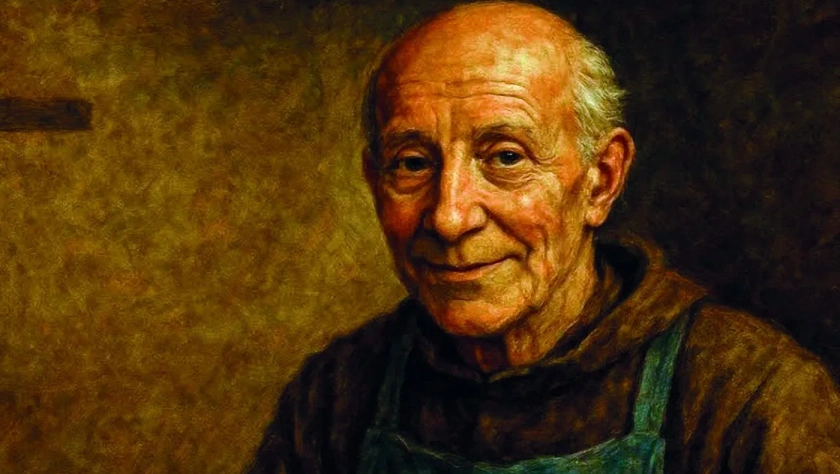
Nicholas Herman was born in 1614 in Lorraine, into a deeply Christian family. Following in the footsteps of his uncle Nicholas, at the age of 26, he entered the Carmelite convent in Paris as a lay brother. He received the name Brother Lawrence of the Resurrection. His life there was marked by prayer and manual labor. He was a cook for 15 years and, later, the shoemaker of his convent.
His name encapsulates his entire mission. His whole life radiates the presence of the Risen Christ. He found the hidden pearl of God’s presence in his heart. As he himself affirms:
« How happy we would be if we could find the treasure of which the Gospel speaks! Everything else would seem insignificant. Since it is infinite, the more one seeks it, the more riches one finds.” Let us be constantly occupied in seeking Him, let us not give up until we have found Him… What could I possibly fear when I am with God? » (Letter 5).
This presence, experienced in daily life, fulfilled all his desires, radiating the flame that consumed him so intensely that he expressed his experience thus:
« The presence of God is, in my opinion, what the whole spiritual life consists of, and it seems to me that, by practicing it properly, one becomes spiritual in a short time… There is no sweeter or more delightful way in the world than continuous conversation with God; only those who practice and savor it can understand it » (Letter 3).
« The holiest, most common, and most necessary practice in the spiritual life is the presence of God: it consists in taking pleasure in and becoming accustomed to His divine company, speaking humbly and conversing lovingly with Him at all times, in every instant, without rules or limits, especially in times of temptation, sorrow, spiritual dryness, listlessness, and even infidelity and sin » (Spiritual Maxims 6).
« I have God », he affirms,« with the same tranquility in the hustle and bustle of my kitchen, where sometimes several people ask me for different things at the same time, as if I were kneeling before the Blessed Sacrament. » (Fourth Conversation, November 25, 1667, transcribed by Abbot Joseph de Beaufort).
« We must make our hearts a spiritual temple for God, where we adore Him without ceasing. We must watch over ourselves tirelessly so as not to do, say, or think anything that might displease Him » (Letter 15).
The Father truly seeks one of these worshippers:
« My most habitual way is that simple attentiveness and that general, loving gaze toward God… As for my hours of prayer, they are nothing more than a continuation of that same practice. Sometimes I consider myself in them like a stone before a sculptor who wants to make a statue of me; Presenting myself thus before God, I beg Him to form His perfect image in my soul and to make me entirely like Him »(Letter 2).
At the beginning of 1691, Brother Lawrence fell ill. As his condition worsened, he received the sacrament of the sick. When a religious asked him what he was doing and what occupied his mind, he replied: « I am doing what I will do for all eternity: I bless God, I praise God, I adore Him and I love Him with all my heart; that is our whole task, my brothers, to adore God and to love Him, without worrying about anything else » (Eulogy 59). Then, with the peace and tranquility of one who sleeps, Brother Lawrence died on February 12, 1691, at the age of 77.
Thank you, Brother Lawrence, for helping us, in such a simple way, to quench our thirst for an authentic life with the Lord.
We want to pray with you:
« My God, since you are with me and, by your command,
I must apply my spirit to these external things,
I beg you to grant me the grace
to remain with you and keep you company;
but for this to be better, my Lord, work with me,
accept my works, and possess all my affections. »
(Eulogy 30)