
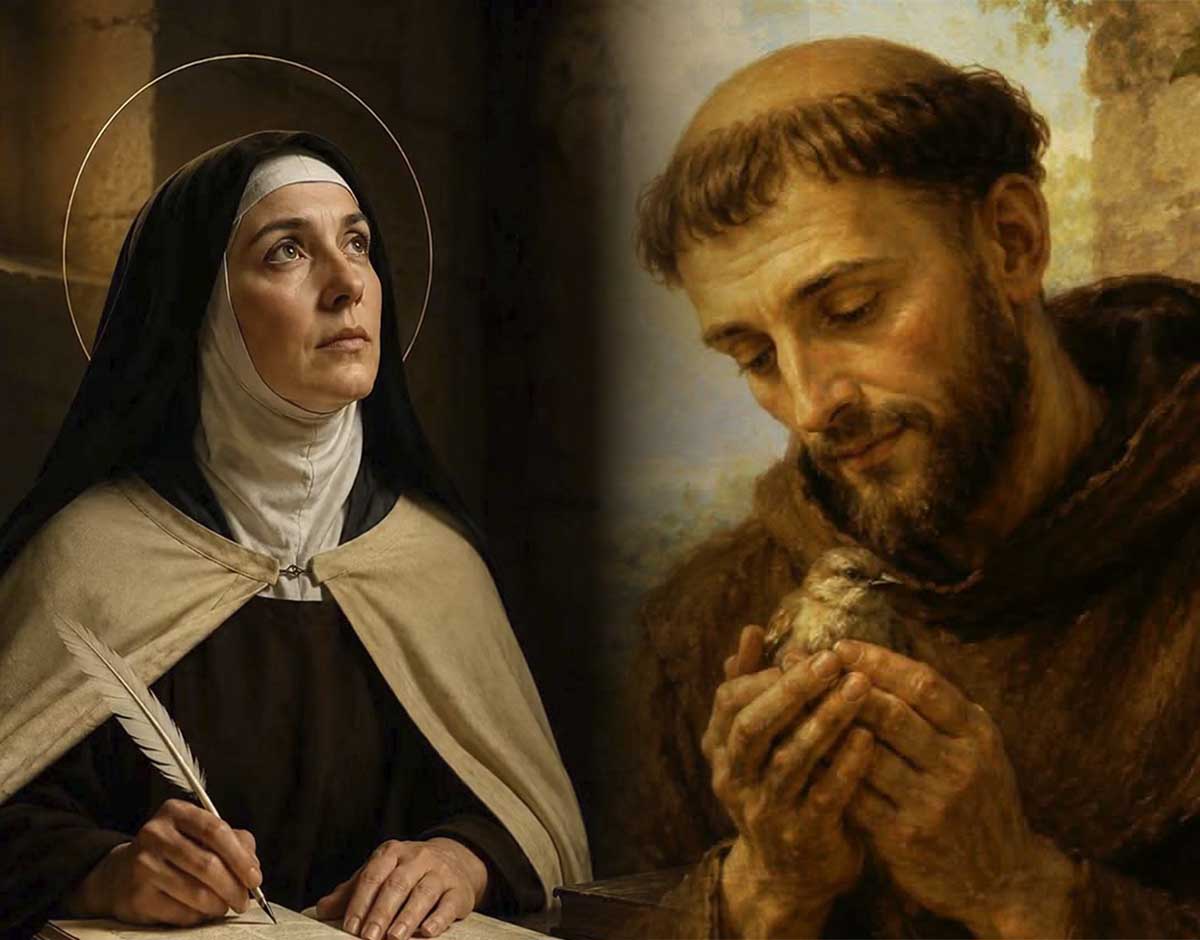
This year we are celebrating the 800th anniversary of the death of St. Francis, the “Poverello of Assisi,” and for that reason I would like to invite you to contemplate the influence of the Franciscan spirit on Our Mother Teresa of Jesus, who entered into a profound communion with the Franciscan vision of Lady Poverty, making this ideal the cornerstone of her own reform. Let’s begin!
Francis was born in Umbria in 1181/1182 and died on October 3, 1226. Teresa was born in Castile on March 28, 1515, and died on October 4/15, 1582. (1) Although separated chronologically by more than three centuries, both are absolutely united by the same mystical and radical vision of evangelical poverty.
Teresa hesitated, both practically and legally, about whether she should found the Monastery of St. Joseph with an income or in absolute poverty. It was at this moment that, providentially, she met Sister María de Jesús (María de Yepes) (2). Teresa confessed that this encounter moved her deeply and had a direct impact on the model for founding the first convent of the Discalced Carmelites. « Teresa’s radical shift—from planning a convent with moderate income to one in absolute poverty—was the fruit of a charismatic harmony with early Franciscanism, validated by the experience of Sister María de Jesús » (3). The opinion of Saint Peter of Alcántara, who was already Teresa’s chief advisor, coincided with that of the Blessed regarding founding the convent in absolute poverty.
We can say that the influence of the Franciscan spirit (radically embodied in Saint Peter of Alcántara) was the definitive catalyst that transformed Saint Teresa’s doubts into the determination necessary to carry out her reform. Thus, the Franciscan imprint endowed the Carmelite reform with its most iconic feature: blind trust that Providence would provide, allowing the nuns to live with absolute spiritual freedom by having nothing material to defend.
Teresa was a daughter of the Carmelite tradition; however, the mysticism of « detachment» and absolute dependence on Providence were directly linked to the movement initiated by St. Francis of Assisi and revived by St. Peter of Alcántara in Teresa’s time.
Teresa manifests this communion with Lady Poverty in the « Way of Perfection »:
1. Poverty: Dignity and Sovereignty. Having nothing material was the only way to possess everything in God.« Poverty is a good that contains within itself all the world’s goods. It is a grand sovereignty. I say that whoever cares nothing for the goods of this world holds sovereignty over them all once more.»(4)
2. Poverty: the convent’s great defensive « wall». « Mighty are the ramparts of poverty.» (5)
3. Contempt for dowries and social wealth. In full harmony with the Franciscan charism, Teresa warns that the moment money enters the door to provide « security», the spirit of Carmel will be destroyed: «Worrying about the revenues… Leave that care to Him who can move them all, who is the Lord of both the revenues and the rent-payers.»(6)
4. Freedom in the face of the powerful. The rich are always slaves to those they need to maintain their status, while the truly poor owe nothing to anyone: «True poverty brings a monumental honor with it that no one can withstand; poverty that is embraced for God alone, I say, has no need to please anyone but Him.» (7)« What do I care about kings and lords if I do not want their revenues, nor care to keep them pleased, if it means displeasing God even a single bit for their sake?»(8)
We can clearly see how Teresa assimilated the mysticism of Lady Poverty: for her, poverty was not about going hungry on a whim, but rather a radical exercise of trust in Providence and the only path to achieving absolute detachment from the ego and the vanities of the world.
Teresa and Francis. Though they belonged to different eras, geographical landscapes, and religious orders, through Teresa’s encounter with Saint Peter of Alcantara—which was no mere historical coincidence—a mystical attunement with the spirit of Francis took root within her. The distance of time is completely dissolved by the mystical experience : Teresian Carmel was born with the contemplative structure of the desert, but with a heart set ablaze by Lady Poverty in the spirit of the « Poverello of Assisi ».
__________________________
(1) Saint Teresa’s death occurred on the night of the change to the Gregorian calendar, so the date went directly from October 4th to October 15th. 1582)
(2) Book of Life, 35.1
(3) Fr. Tomás Álvarez, OCD
(4) Way of Perfection, 2.5
(5) Way of Perfection, 2.8
(6) Way of Perfection, 2.2
(7) Way of Perfection, 2.6
(8) Way of Perfection, 2.5