
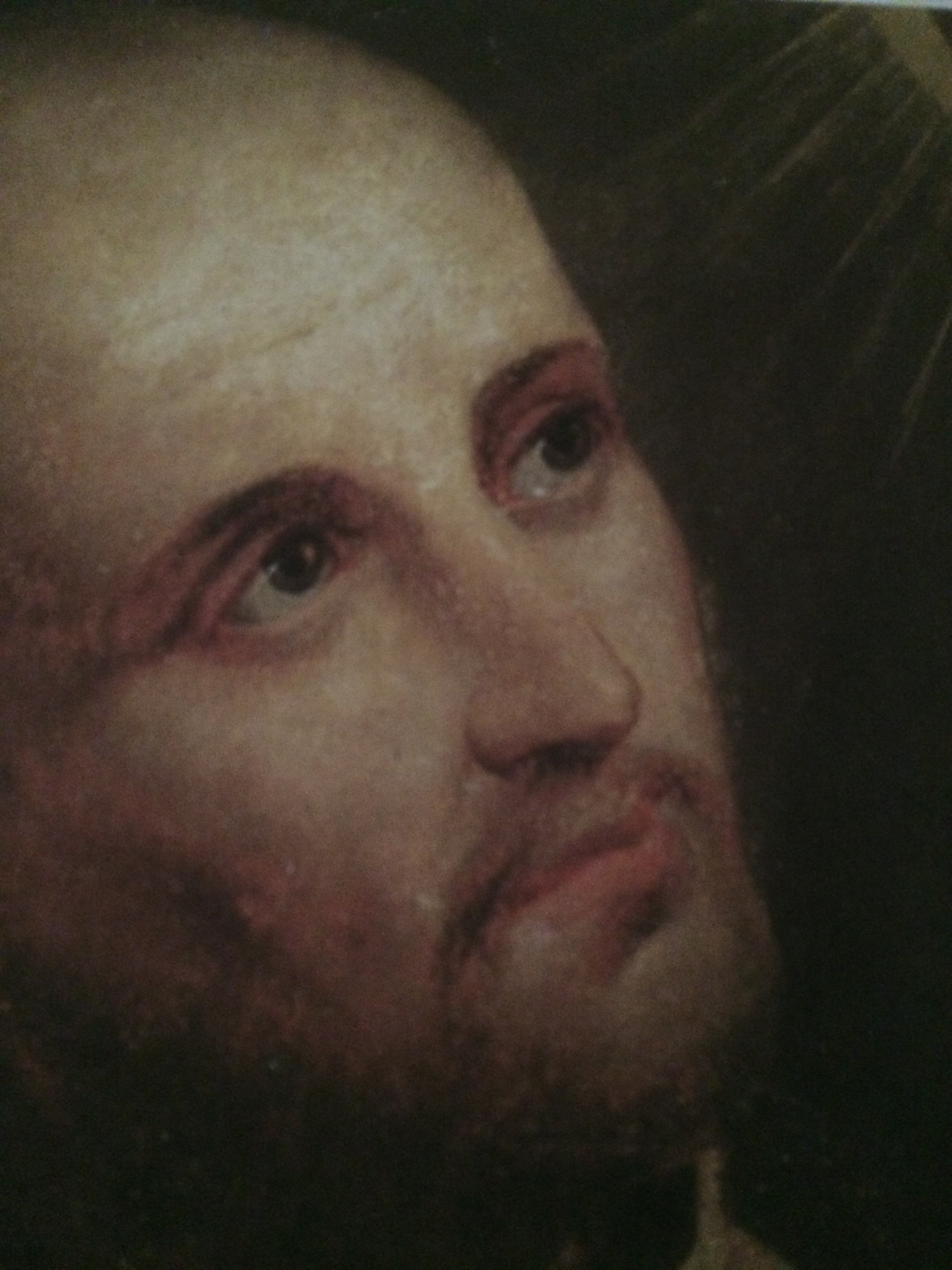
Saint John of the Cross’ roots in the Elianic prophetic tradition were based, in the 16th century, on Philippe Ribot’s compilation made at the end of the 14th century: it is the Decem libri de institutione and peculiaribus gestis religiosorum carmelitarum1. The Carmelites, until the beginning of the XXth century, considered Book I of this work, the Institution of the monks (IPM 1), as the Primitive Rule, prior to Saint Albert’s Rule. In Avila, a codex in the library of the Incarnation contained the Decem libri translated into Castilian, its reading by Teresa of Jesus was probably the origin of her idea of reform. Father Jeronimo de san Jose
argues that John read Ribot’s book, the Decem libri, before embracing the Reforme.
Before quoting St. John of the Cross’ texts which make explicit reference to the prophet Elijah, it should be noted that in the very first Constitutions of the reform, those of the first Chapter of Alcala in 1581, while Saint Teresa was still alive and in the presence of St. John of the Cross at the Chapter, exactly three centuries after the Constitutions of 1281 which contained the Rubrica Prima “quo et quomodo”, this one is reproduced after the Prologue, in the First Chapter2. It says: “In order to bear witness to the truth we say that from the prophets Elijah and Elisha, pious inhabitants of Mount Carmel, the holy Fathers of the Old and New Testaments, passionate friends of this solitary Mount for contemplation, undoubtedly lived there in a manner worthy of praise, near the source of Elijah, observing the holy penance continued without ceasing with holy progress.” Carmel’s dependence on its Father and
Founder was present from the beginning in the legislative code of the Teresian Carmel.
The explicit biblical quotations on the prophet Elijah in Saint John of the Cross and the divine union
Deeply steeped in the institution of the first monks3 , St. John, one might say, “remained in Carmel” – an allusion to his work The Ascent of Carmel – as the prophets’ disciple had to “stand in Carith”. There is no direct reference in John’s works to this passage from the book of Kings (1K 17:1-64), as is also the case with Teresa of Avila’s work. This proves that it is not by quotations that one refers to a tradition, but the deeply integrated tradition that emerges in the whole life of the disciple. The preamble that summarizes the project of The Ascent of Carmel – and in fact its entire work – is formulated by Saint John himself in the following words: “In which it is explained how a soul is formulated by Saint John himself in these terms: “In which it is explained how a soul can be disposed to reach divine union in a short time. It gives very useful advice to beginners and to those who are advanced, to teach them to get rid of all that is temporal, not to be embarrassed by what is spiritual, and finally to establish themselves in the sovereign and freedom of the spirit required for divine union5”. In The Ascent of the Carmel and the dark night is summarized the first way proposed by the Institution of the first monks. Saint John calls it lo activo, and illustrates it with the verse from Deuteronomy “You shall love the Lord your God with all your heart, with all your soul and with all your mind” (Dt 6, 5), which also appears in the Institution. The second, lo passivo, he summarizes in the Vive Flamme: “When the soul has accomplished all that depends on it, it is impossible that God from his side does not do all that is necessary to communicate himself to her” (VFA 3, 40/VFB3, 46).
The “mystical doctor” will therefore refer to the Prophet in order to illustrate the desired union between the soul and his God: for him, Elijah is above all the one “who sees God in the whistling of the wind”. Five texts out of six mention the vision of
the Prophet at Mount Horeb (1Ki 19:13). In The Ascent of the Carmel, St. John will first write: “Our Father Saint Elijah on the Mount covered his face in the presence of God, which means blinding the mind. What he did then not daring to throw a hand so low
on a thing so high, obviously knowing that whatever he had considered and heard would have been very different and unlike God” (MC 2, 8, 4). But a little further on he corrects himself, reproducing the opinion of Saint Thomas who says that Saint Paul and Moses enjoyed the vision of the divine essence6; what Saint Basil also grants to Elijah: “The substantial visions in this high degree,
like those of St. Paul and Moses, that of Elijah, our Father, when he covered his face under the gentle breath of God, take place only very rarely, or even almost never, and for very few people. In the Spiritual Canticle, John takes up the theme of substantial vision:
“Because this whispering of the breeze signifies substantial knowledge, some theologians hold that our Father Elijah saw God himself in that breath of light breeze which was felt to him on the Mountain, at the entrance to the cave where he stood. Here, this knowledge is an outpouring, in the soul’s understanding, of the loving communication of the perfections of the Beloved…” (CSB 14-15, 14). As Teresa, regarding the prayer of union, evokes our first Institution (D V, 1,2), John, having reached the description of the spiritual engagement, evokes Elijah in the Canticle spiritual A:
“In my Beloved I have the mountains,
the lonely and shadowy valleys,
the prodigious islands,
the rivers with their mighty sound,
the whistling of the winds of love.
“…our Father Saint Elijah saw God in the whistling of this small wind that he felt in the mountain at the entrance to the cave. And you notice that the Scripture calls it there the whistle of a delicate wind because, from the subtle and the Spirit’s delicate
communication came the intelligence in the understanding.” (CSA 13-14, 14).
Having reached the state of spiritual marriage, the soul may say: “You gave the Prophet a stronger feeling in the form of a delicate whisper of air… only those, O my God and my life, who will see you and feel your delicate touch, who, moving away from the world, will have put themselves in a delicate state… so they will be able to feel you and enjoy you” (VFA 2,17). Or again: “O light and infinitely light touch of the Father. All the lighter for me that after having overthrown the mountains and broken the rocks on Horeb by the shadow of your power and of the strength that went before you, you revealed yourself to the Prophet in the breath of a light breeze. O light breeze, tell me how you can be a light breeze…” (VFA 2, 16/VFB 2, 17). In The Living Flame verse 4, the Spouse of the soul in the state of union transforming is the Holy Spirit himself, he is the one who produces acts in the soul and, nevertheless, the soul deserves more by one of these acts than for all that she has done in the rest of her life. Strengthened in her will, the soul has become capable of loving and tasting the Lord without her nature failing: “By your sweet spiration, full of riches and glory, how sweetly you intoxicate me with love!”
It is a spiration of the Holy Spirit in God himself, the force of love corresponds then to the sublimity of knowledge: “The Holy Spirit attracts the soul to himself in proportion to the knowledge which has just been communicated to him. The soul finds herself very deeply immersed in the Holy Spirit who embraces her with a suave and sublime love, corresponding to what that she has been given to discover ” (VFB 4,16). This is where the teaching ends and becomes inexpressible: “Therefore I will say no more.”
Conclusion
Recently, we have been able to read with a different eye Father Nicolas le Français’ pamphlet, The Arrow of Fire7(1270), to recognize in this first text written by a Carmelite Father, a precious witness to his spirit in its first century of existence. It then
became clear that St. John of the Cross ’spirituality has remained surprisingly close to the original tradition. Father François de Sainte Marie was perhaps the first to emphasize this proximity through the centuries: “In these pages, the contacts with St.
John of the Cross are numerous. All the Sanjuanist themes, or almost all of them, are already present: the absolute transcendence of God with whom the creature has no proportion, the theological virtues which alone truly join the soul to the divinity, purity of heart and right conscience, attention to God alone, contemplation, mortification of the senses and of the tongue, fight against the three enemies of the soul. The “Mystical Doctor” is attached to a secular tradition. He knew how to give a
very personal turn to his teaching, it is however in the old field of his Fathers, in the land of Carmel, that he sought and found the rare pearl of contemplation of which Saint Theresa speaks the elian spirit of solitude, of silence, of the hidden life of which
Nicolas le Français was in love with.8 Edith Stein writes about John of the Cross: “We find in him the eremitical spirit in its purest expression. (…) He was the instrument chosen to live and teach, in the heart of the reformed Carmel, the spirit of the holy
Father Elijah”.9
Modern authors have difficulty in finding the sources of Saint John of the Cross because they ignore the Carmel tradition. Nor do they take into account all that he, the great poet, was able to receive from oriental spirituality, he, the great poet, through the liturgy of the Holy Sepulchre: it was largely constituted by the Gallo- Roman rite, however, when the canons of the Holy Sepulchre celebrated in their divine office the mysteries of Christ, His passion, His death and His resurrection, they did so in the very places where these mysteries had been celebrated for the first time. It was therefore natural that this fact should encourage them to celebrate the Mysteries of our Redemption with great solemnity, as the Orthodox Church did, before their eyes, in the Holy Sepulchre itself. In these evocations of the prophet Elijah at Horeb, it is the time of the peak of contemplation that John evokes: perfect union, the anticipated vision of God, the greatest love, the highest science. The Fathers: Athanasius, Jerome, Cassian and many others, saw in Elijah the monks’ father; moreover, in John, he is the spiritual guide who accompanies the monk to Horeb, until his passage into God. He has reached prophetic perfection the one who, as a forerunner, smoothes out and makes straight
the path of the disciples, then reveals to them the substantial touch of Horeb, the passage from the ear to the eye: “Until now, I knew you only through what my ears heard. But now I have seen you with my eyes” (Job 42:5). Teresa of Avila and John of the Cross are not the simple heirs of a tradition, they mark a moment of resurgence of the source, a new spurt in creative fidelity,
which still irrigates the land of Carmel today. An original reform in the sense that it allows a manifestation of the origin that has not yet occurred.
Carmel of the our father – Jerusalem
1 Latin text in Daniel of the Lady, Speculum carmelitanum, 1507.
2 Constitutiones Capituli Complutensis 1581. Cap. 1, [n. 17]. Edit. Fortunatus a Iesu-Beda a SS. Trinitate, Constitutiones
Carmelitarum Discalceatorum 1567-1560, Roma 1968, p. 34-35.
3 Philippe Ribot, L’institution des premiers moines, trans. sr. P.-D. NAU, o.p., Introd. and Annexes by Jean-Philippe Houdret,
OCD, ed. of the Carmel, Toulouse 2013.
4 1Ki 17:1-5: “The word of YHWH came to him, saying, ‘Go from here; you shall go eastward and hide yourself at the stream of
Kerit, which is on the east side of the Jordan; you shall drink from the stream, and I have commanded the ravens to provide for
you sustenance there. “So, he went and did as YHWH had said, and went and dwelt at the stream of Kerit, which is east of
Jordan. The ravens brought him bread in the morning and meat at night, and he drank from the stream.”
5 John of the Cross, MC, Presentation, OC, Cerf, p. 567.
6 Thomas d’Aquin, ST I, 11, Cerf 1990.
7 La flèche de feu, Abbaye of Bellefontaine, coll. Flèche de feu n° 3, Bégrolles-en-Mauges 2000.
8 François de Sainte Marie, « La flèche de feu », PVT, 1945, p. 155.
9 Edith Stein, “Le Carmel”, translated in La Splendeur du Carmel n°2, Beirut, 1993, p. 6.