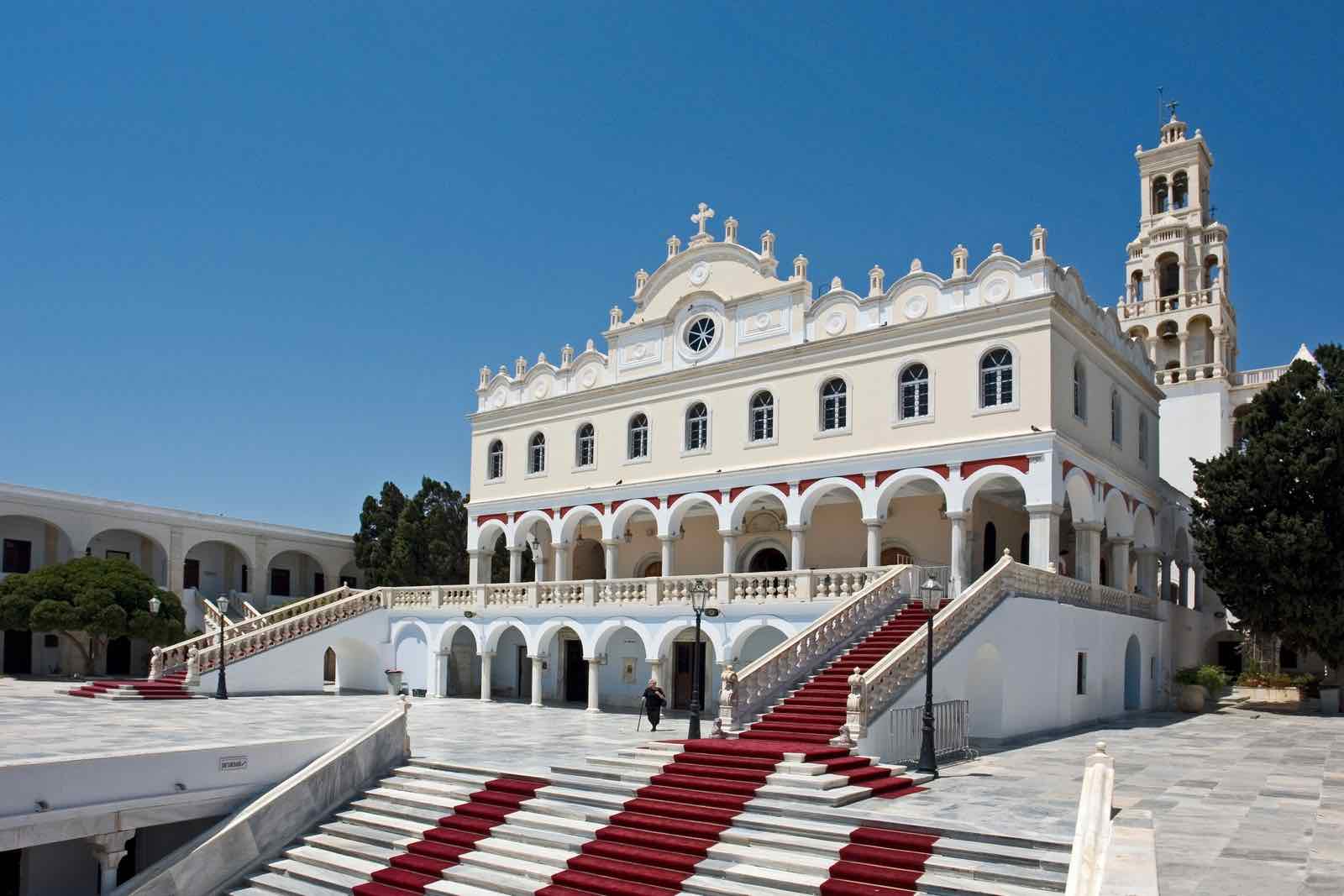
The Feast of the Dormition is a major celebration, with Orthodox and Catholics coming together to celebrate the Mother of God, “the PANAYEIA,” the ALL-HOLY ONE.
The Virgin Mary is indeed much loved in Greece, where she is given around 500 names that define places or events marking her presence or her actions. She is represented in countless icons, and there are many monasteries dedicated to her and pilgrimages devoted to her. Among these, the pilgrimage on August 15 to Tinos is certainly the most famous and most popular. It was dear to our Greek sisters. Tinos, a small island in the Cyclades, is inhabited by many Orthodox Christians but also by a relatively large community of Catholics, where relations between Christians are quite harmonious.
On July 28, 1822, the Virgin Mary appeared three times to Sister Pelagia, an elderly Orthodox nun. The Holy Virgin ordered her to tell the bishop that he must excavate the land of “Doxaras,” where he would find a very ancient buried icon, and build a church. Indeed, after many difficulties, this icon was found. This icon of the Annunciation is so beautiful that people believe that Saint Luke himself created it (according to legend, he painted 70 of them). Miracles occurred, and the faithful flocked from all over, as this manifestation of the Holy Virgin Mary gave them hope. Immediately after this discovery, the news spread rapidly throughout the Greek world. People came from all corners of Greece to prostrate themselves humbly before the Holy Icon, confide their health concerns, and pray for the liberation of the nation.
The pilgrimage to Tinos is for the Greeks like that of Lourdes in France, and on August 15, the Virgin is celebrated with great solemnity. After the Divine Liturgy, the icon is carried in procession through the streets on a stretcher by sailors, accompanied by a brass band, military and religious music, and attended by religious and civil authorities. People jostle to try to touch the Holy Icon, expressing their faith and love for the PANAYEIA. The history of the pilgrimage and the contemporary history of the Greek state go hand in hand. The discovery of the Holy Icon in 1823 was considered a divine omen for the rightness and success of the uprising against the Turkish occupiers, while the construction of this imposing church was the first major architectural work of the young Greek state.