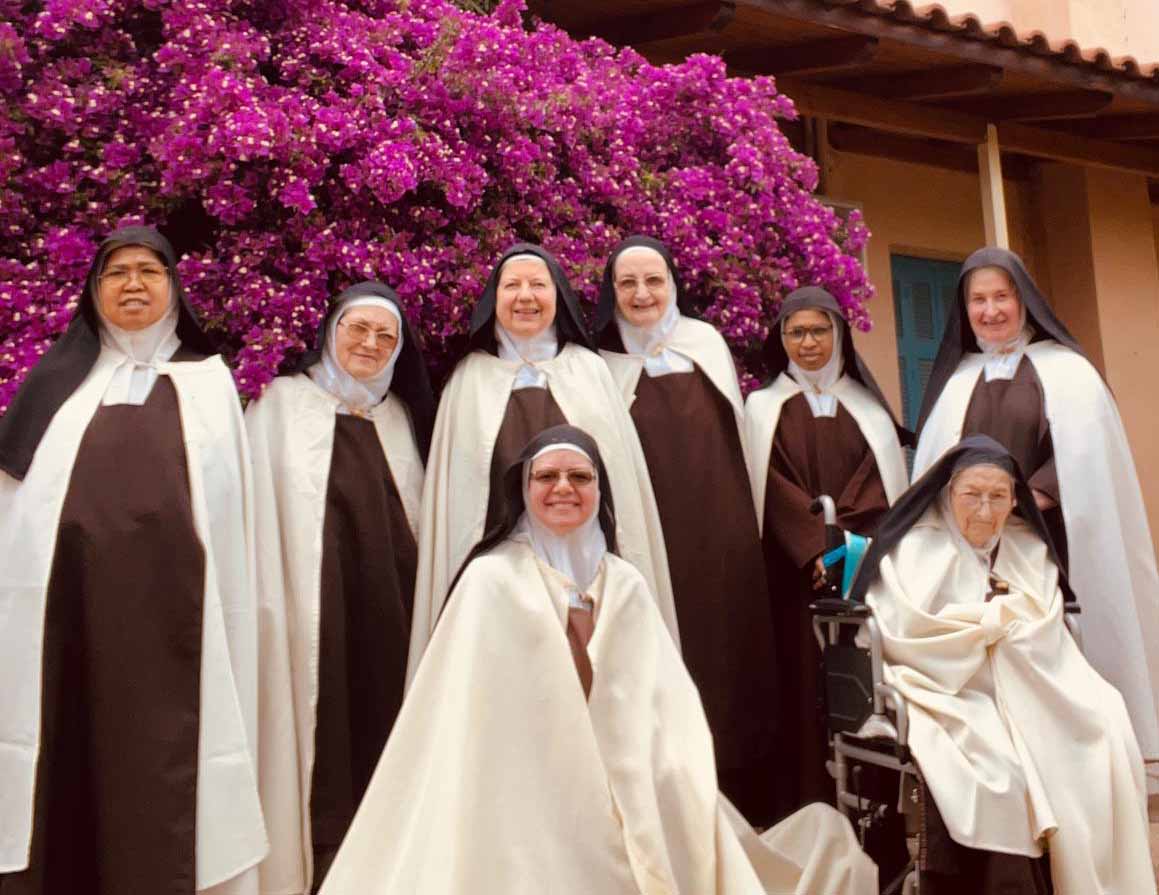
Community of Athens – Greece
«…I noticed, as I strolled round admiring your sacred monuments,
that you had an altar inscribed: To An Unknown God.
Well, the God whom I proclaim is in fact the one whom
you already worship without knowing it. »
(Paul’s speech before the Areopagus, Athens – Acts 17:23)

The monastery is dedicated to the Holy Trinity and the Mother of God. The Carmel of Athens is the only Carmelite convent in Greece, as well as the only Catholic contemplative monastery in mainland Greece. It is located in a country where Catholics are a large minority (approximately 2%).
On March 25, 1927, Chancellor Filippucci was appointed Archbishop of Athens. He received episcopal consecration from Monsignor Roncalli, the future Saint John XXIII, then Apostolic Nuncio to Turkey. On that day, Monsignor Roncalli, Monsignor Vuccino, and Monsignor Filippucci entered the cloister of the Carmelite convent of Constantinople. The new archbishop then expressed his strong desire to have a Carmelite convent in his diocese of Athens. He wanted the
Daughters of Saint Theresa to be there, through prayer and sacrifice, the auxiliaries of a very difficult evangelization. But also so that through their union with God, they would serve profoundly, in silence and solitude, to the cause of Unity so delicate in Greece. During a trip to Rome, Mgr Filippucci submitted to Pope Pius XI the project that was close to his heart, and the latter replied without hesitation: “Yes, God wills it, make the foundation of this Carmel.”
Bishop Filippucci made the official request on 27 July 1933. His own cousin, Sister Thérèse de Jésus (Filippucci), was chosen to be the founder, at the age of 33. She left the Carmelite convent in Constantinople alone on 6 November 1933 to prepare the foundation, with the utmost discretion, in civilian clothes and with special powers from the Holy See. A benefactress offered the money needed to buy the land, but the government refused planning permission. In 1934, the archbishop bought a piece of land on a hilltop in a small village overlooking the Greek capital, with a view of the sea and no neighbours. He declared it as agricultural domain and obtained permission to build a small farmhouse. ‘The Congregation for the Propagation of the Faith,’ to which Greece then belonged as a mission territory, authorised the foundation on 7 January 1935.
« …it is in him that we live, and move, and exist. »
(Acts 17:28)